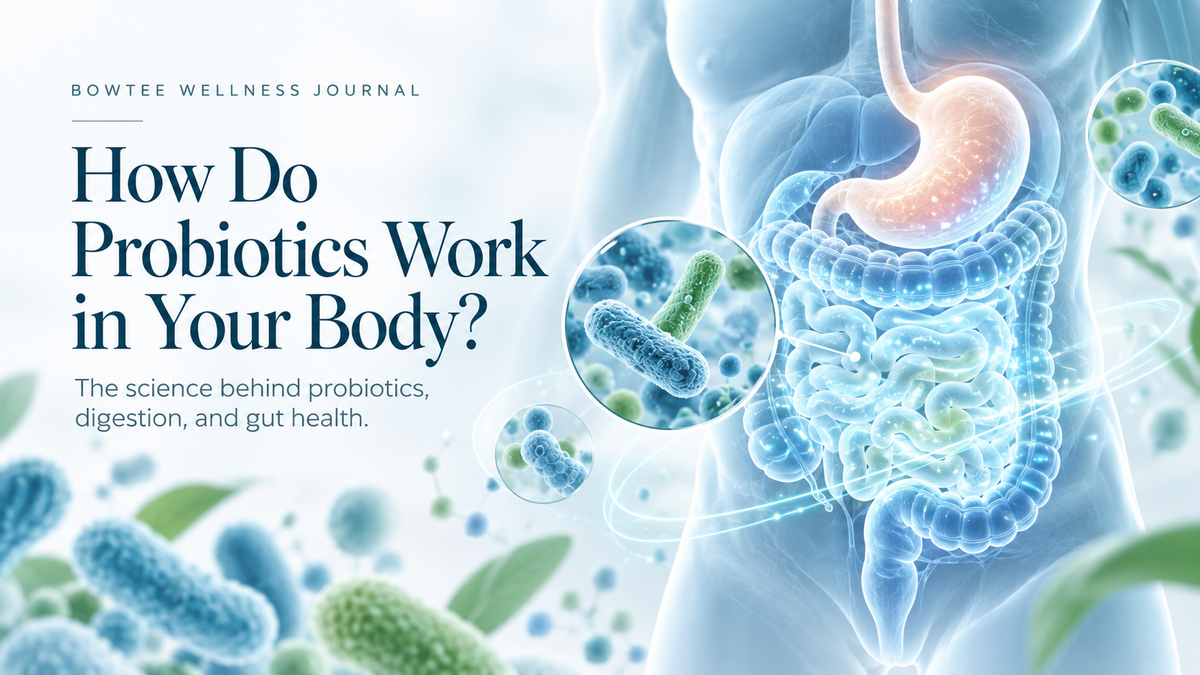
BOWTEE WELLNESS JOURNAL / PROBIOTICS 101
How Do Probiotics Work in Your Body?
Explore the science of probiotics, the gut microbiome, digestive wellness, and immune interactions.

Your digestive system is much more than a place where food is broken down. It is home to a complex community of microorganisms that interact with your body every day.
Among these microorganisms are bacteria that play important roles in the intestinal environment. Scientists are exploring how probiotics may influence digestive function and other aspects of human health.
But what actually happens when you take probiotics? Do they survive digestion? Do they become part of your gut microbiome? And how might they interact with your immune system?
Let's explore the science.
1. What Happens When Probiotics Enter Your Body?
When you consume a probiotic supplement or a food containing probiotics, the microorganisms travel through your digestive system.
The journey typically begins in the mouth, continues through the stomach, and proceeds into the intestines.
Along the way, microorganisms may encounter challenging conditions, including stomach acid and digestive substances.
Not every probiotic strain survives these conditions equally well. Survival depends on several factors:
- The specific microorganism and strain
- The product formulation
- Processing and storage conditions
- The surrounding digestive environment
Some microorganisms may reach the intestines alive and interact with the intestinal environment.
Importantly, probiotics do not necessarily need to permanently colonize the gut to produce a beneficial effect.
Many strains are transient, meaning they pass through the digestive system rather than becoming permanent residents.

2. How Probiotics Interact With Your Gut Microbiome
Your gut microbiome contains bacteria, archaea, fungi, viruses, and other microorganisms.
Together, these organisms form a dynamic ecosystem influenced by diet, age, medication, health status, and lifestyle.
Researchers have identified several ways that certain probiotics may interact with this ecosystem.
Competing With Other Microorganisms
Some probiotic strains can compete with other microorganisms for available nutrients or attachment sites.
In laboratory settings, certain strains also produce substances that can influence the growth of other microbes.
These effects vary considerably between strains and do not guarantee a particular health outcome.
Producing Biologically Active Substances
Some microorganisms produce compounds such as organic acids or other metabolites.
These compounds may influence the local intestinal environment or interact with other microorganisms.
Interacting With Existing Gut Bacteria
Probiotic microorganisms may influence microbial activity without causing permanent changes in the overall microbiome.
Scientists continue to investigate which changes are meaningful for human health.
3. The Relationship Between Probiotics and the Gut Barrier
The intestinal barrier forms an important interface between the contents of your digestive tract and the rest of your body.
It includes intestinal epithelial cells, mucus, immune components, and other protective structures.
A properly functioning intestinal barrier allows nutrients to be absorbed while helping regulate interactions with microorganisms and potentially harmful substances.
Research suggests that certain probiotic strains may interact with intestinal epithelial cells and influence mechanisms involved in barrier function.
However, evidence of a biological mechanism does not automatically mean that a supplement improves intestinal barrier function in every person.

4. How Probiotics May Interact With Your Immune System
The digestive tract is closely connected to the immune system.
Immune cells within intestinal tissues constantly interact with microorganisms and substances in the surrounding environment.
Researchers are investigating how selected probiotic strains may influence immune signaling and immune-cell activity.
These interactions are sometimes described as immunomodulation.
Immunomodulation does not simply mean "boosting" the immune system.
A healthy immune response involves recognizing potential threats while maintaining appropriate tolerance toward harmless substances.
Different strains may interact with immune processes in different ways. Findings from one probiotic strain cannot automatically be applied to another.
5. Do Probiotics Help With Digestion?
Certain probiotic strains have been investigated for digestive conditions and gastrointestinal symptoms.
Research has examined applications involving:
- Antibiotic-associated diarrhea
- Some forms of gastrointestinal discomfort
- Certain functional digestive disorders
- Other specific gastrointestinal conditions
For some applications, clinical studies have shown potential benefits.
For others, the available findings are inconsistent or insufficient.
The effectiveness of a probiotic depends on more than whether it contains live bacteria.
Factors such as strain identity, dose, treatment duration, and individual health characteristics all matter.
6. How Long Does It Take for Probiotics to Work?
There is no universal timeline.
Different clinical studies evaluate different strains, doses, populations, and health outcomes.
Some research measures changes over days, while other studies evaluate outcomes over several weeks or longer.
Whether an individual notices a difference depends on the product, the reason for using it, and their personal circumstances.
Taking a probiotic for a longer period does not necessarily mean it will become more effective.
7. Why Different Probiotic Strains Matter
One of the most important concepts in probiotic science is strain specificity.
Even closely related microorganisms may have different properties.
Two strains belonging to the same bacterial species may not produce identical results in clinical research.
Genus: A broad group of related microorganisms.
Species: A more specific biological classification.
Strain: An identified microorganism within a species.
When evaluating probiotic research, consumers should look for studies examining the actual strain included in a product.
8. How to Support Your Gut Microbiome Naturally
Probiotics are only one part of the broader gut-health picture.
Everyday habits can influence the digestive environment and support general well-being.
Eat a Variety of Plant Foods
Vegetables, fruits, legumes, whole grains, nuts, and seeds provide different types of dietary fiber and nutrients.
Include Fiber-Rich Foods
Many gut microorganisms can utilize components of dietary fiber.
Their metabolic activity can produce compounds such as short-chain fatty acids, which are involved in intestinal physiology.

Maintain Healthy Sleep Habits
Adequate sleep contributes to overall health and is an important part of a sustainable wellness routine.
Stay Physically Active
Regular physical activity supports general health and can contribute to healthy digestive habits.
Make Informed Supplement Choices
If you are considering probiotic supplementation, evaluate the strain information, supporting research, quality standards, and intended use.
A supplement should complement, not replace, an appropriate diet and medical care.
DISCOVER BOWTEE
9. Discover the Science Behind BOWTEE
At BOWTEE, understanding probiotic ingredients is an important part of exploring the brand's nutritional formulations.
The BOWTEE probiotic range includes multi-ingredient formulations with identified bacterial strains.
When choosing a probiotic product, it is helpful to review the ingredient list, available strain-specific research, storage requirements, and recommended directions for use.
Rather than focusing only on the number of strains or the highest advertised CFU count, informed selection starts with understanding what is actually in the product.
Frequently Asked Questions
Do probiotics stay in your gut permanently?
Many probiotic strains are temporary visitors to the digestive system. Permanent colonization is not required for every potential probiotic effect.
Do all probiotics work the same way?
No. Different probiotic strains may have different biological properties and effects.
Can probiotics change your gut microbiome?
Some probiotics may influence microbial activity or the intestinal environment, but consistent and lasting changes in overall microbiome composition are not guaranteed.
Can probiotics support immune health?
Certain probiotic strains have been studied for their interactions with immune responses. These findings cannot be generalized to every probiotic product.
Are probiotics safe for everyone?
No. Although many healthy people tolerate commonly used probiotics, individuals with serious illnesses or weakened immune systems may face additional risks. Premature infants are particularly vulnerable to serious infections associated with probiotic use.
Consult a qualified healthcare professional before using probiotics if you have underlying medical conditions or concerns.
Final Thoughts
Probiotics interact with the body through a range of complex biological pathways.
Depending on the strain, these interactions may involve other microorganisms, intestinal epithelial cells, metabolites, and immune processes.
Yet the most important lesson is that not all probiotics work in the same way.
Understanding the science behind specific strains and recognizing the limits of current research can help consumers make more informed decisions.
Continue learning with the BOWTEE Wellness Journal, where probiotic science meets practical everyday wellness education.
Scientific References
Image Credits & Licenses
Digestive system diagram: LadyofHats, Public Domain. Source. Intestinal villus: Snow93, Public Domain. Source.


Lactobacillus acidophilus image: Mogana Das Murtey and Patchamuthu Ramasamy, CC BY-SA 3.0. Source. Used without modification.

Blueberry oatmeal: Shisma, CC BY 4.0. Source. Used without modification.

Medical Disclaimer: This article is for general educational purposes only and does not constitute medical advice. Dietary supplements are not substitutes for appropriate medical diagnosis or treatment. Consult a qualified healthcare professional before starting supplements, especially for children or individuals with underlying medical conditions.