BOWTEE WELLNESS JOURNAL | FOOD & PROBIOTIC SCIENCE
Fermented Foods vs. Probiotic Supplements: What's the Difference?
A practical guide to live cultures, fermented foods, probiotic supplements, and how to evaluate the evidence behind them.
Yogurt, kimchi, sauerkraut, kefir, and probiotic supplements often appear in conversations about gut health. Because many of these products involve microorganisms, it is easy to assume they all provide the same benefits.
However, fermented foods and probiotic supplements are not interchangeable categories.
Some fermented foods contain live microorganisms, and some may contain microorganisms with demonstrated probiotic benefits. Other fermented foods may contain few or no living microorganisms when consumed.
Understanding this distinction can help consumers make more informed decisions about nutrition and supplements.
1. What Are Fermented Foods?
Fermented foods are made through the desired growth of microorganisms and the chemical changes they produce in food ingredients.
During fermentation, microorganisms can transform carbohydrates and other food components, contributing to changes in flavor, texture, acidity, and aroma.
Examples of fermented foods include:
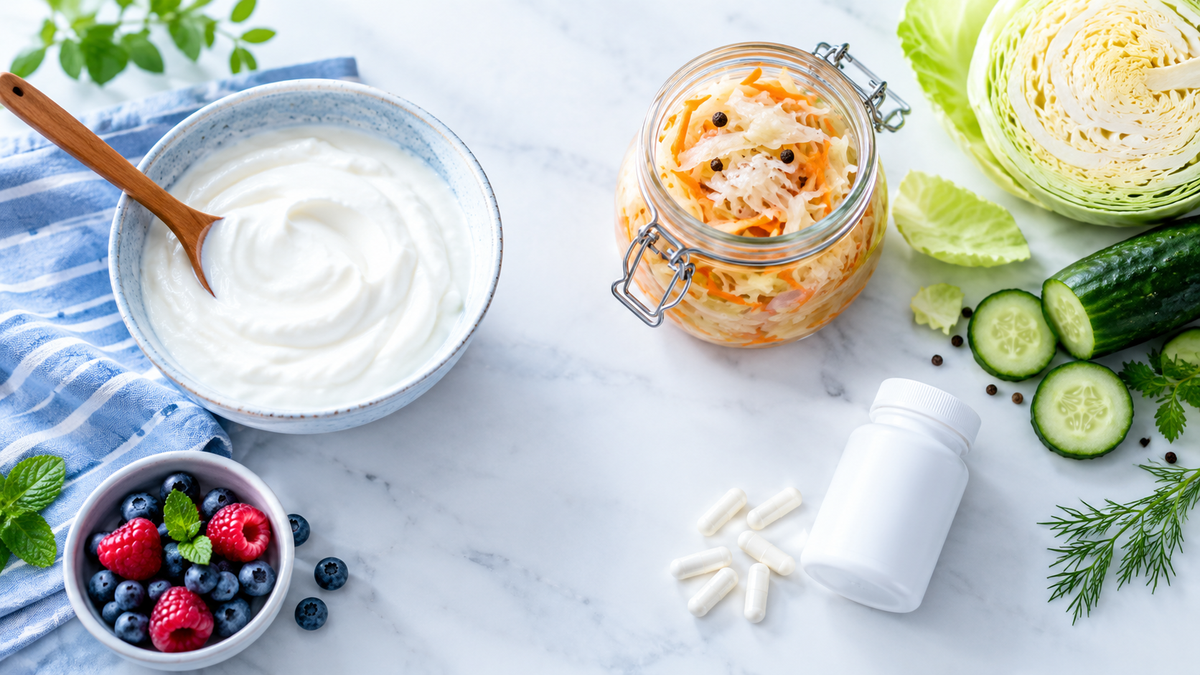
- Yogurt and certain cultured dairy products
- Kefir
- Kimchi
- Sauerkraut
- Miso and tempeh
- Some fermented vegetable products
These foods differ significantly in ingredients, manufacturing methods, nutritional composition, and microbial content.

2. What Is a Probiotic?
Probiotics are live microorganisms that, when administered in adequate amounts, confer a health benefit on the host.
This scientific definition is more specific than simply saying that a food contains bacteria.
To evaluate a probiotic properly, researchers need to understand which microorganisms are present, how much is provided, and what evidence supports the claimed benefit.
For many probiotic products, strain-level identification is important because different strains may have different characteristics.
The presence of live microorganisms alone does not automatically prove that a food or supplement provides a particular health benefit.
3. Are All Fermented Foods Probiotic Foods?
No.
Fermentation describes a food production process. Probiotic describes live microorganisms that have demonstrated a health benefit when administered in adequate amounts.
These concepts overlap, but they do not mean the same thing.
For example, some fermented foods undergo heating, baking, filtration, or other processing steps that remove or inactivate living microorganisms.
Other fermented foods may contain live cultures, but the specific microorganisms and their potential health benefits may not have been adequately studied.
Therefore, it is inaccurate to assume that every fermented food contains clinically established probiotics.

4. How Are Probiotic Supplements Different?
Probiotic supplements are formulated to deliver selected microorganisms in a defined serving.
Depending on the product, they may contain capsules, powders, tablets, or other dosage forms.
Unlike a traditional fermented food, a supplement may identify specific microbial strains and state a viable microorganism count.
However, labels and formulations vary. Not every supplement has been studied in high-quality clinical trials, and a large number of microorganisms does not automatically establish a greater health benefit.
The most useful evidence is specific to the actual microorganism, formulation, amount, and intended use.
5. Fermented Foods vs. Probiotic Supplements
| Feature | Fermented Foods | Probiotic Supplements |
|---|---|---|
| Main purpose | Foods produced through fermentation | Deliver selected microorganisms |
| Microbial content | Varies by food and processing | Varies by formulation and label |
| Strain information | May be limited | May identify specific strains |
| Nutritional role | Can provide protein, fiber, vitamins, or other nutrients, depending on the food | Depends on ingredients and dosage form |
| Clinical evidence | Depends on the food and specific outcome | Depends on the exact strain and intended use |
Neither category is automatically superior for every person or every health goal.
6. What About Yogurt, Kimchi, and Sauerkraut?
These foods can be part of varied eating patterns, but their microbial characteristics differ.
Some yogurts contain live cultures. Certain kimchi and sauerkraut products may also contain live microorganisms, depending on their preparation and processing.
However, pasteurization or other processing may reduce or eliminate viable microorganisms in a finished product.
Consumers should read product descriptions carefully and avoid assuming that every product within a food category has identical properties.

7. Can You Eat Fermented Foods and Take Probiotics?
For many people, fermented foods and probiotic supplements can be considered separately within an overall nutrition routine.
However, taking a supplement is not necessary for everyone, and combining multiple products does not guarantee additional benefits.
People with specific dietary restrictions, medical conditions, weakened immune systems, or complex medication regimens should discuss supplement use with a qualified healthcare professional.
It is also important to consider sodium, added sugars, lactose, and other ingredients that may be relevant to individual dietary needs.
8. How to Read a Probiotic Supplement Label
When evaluating a probiotic supplement, review the details rather than relying only on front-label marketing.
✓ Genus, species, and strain names when provided
✓ Amount per serving and directions for use
✓ CFU information and when the count applies
✓ Storage instructions and expiration date
✓ Manufacturer contact and product information
✓ Research relevant to the exact strain and intended benefit
CFU means colony-forming units, a measure used to estimate viable microorganisms under defined testing conditions. A higher CFU number alone does not prove that one supplement is more effective than another.
9. A Balanced Approach to Gut Health
Gut health is influenced by many factors, including dietary variety, fiber intake, hydration, physical activity, medications, and individual health conditions.
Fermented foods can add variety to a diet, while selected probiotic supplements may be relevant for particular purposes when supported by appropriate evidence.
Neither should be treated as a substitute for medical assessment when symptoms are persistent or concerning.
DISCOVER BOWTEE
Explore Probiotic Education With BOWTEE
BOWTEE shares educational information about probiotic ingredients, product formats, and digestive wellness.
When evaluating any supplement, review its actual label, directions, and available product-specific evidence. Do not assume that every formulation has demonstrated the same health benefits.
Explore BOWTEE Products →Frequently Asked Questions
Are fermented foods the same as probiotics?
No. Fermentation describes how a food is made. Probiotics are live microorganisms with demonstrated health benefits when used in adequate amounts.
Does every yogurt contain probiotics?
Not necessarily. Some yogurts contain live cultures, but processing and the specific microorganisms present matter.
Are probiotic supplements better than fermented foods?
Neither is universally better. Their value depends on the food or supplement, the intended purpose, and the available evidence.
Does a higher CFU count mean better results?
No. The specific strain, dose, formulation, and relevant clinical evidence all matter.
Can fermented foods replace a probiotic supplement?
That depends on the individual and the intended use. Fermented foods and supplements do not necessarily deliver the same microorganisms or benefits.
Final Thoughts
Fermented foods and probiotic supplements can both be part of the wider conversation about nutrition and the gut microbiome, but they are not identical.
Fermentation does not automatically establish probiotic status, and the presence of live microorganisms does not guarantee a particular clinical benefit.
Choose foods for their overall nutritional value and evaluate probiotic supplements according to their specific ingredients, evidence, and intended use.
Scientific References
- NIH Office of Dietary Supplements: Probiotics — Consumer Fact Sheet
- ISAPP Consensus Statement on Fermented Foods
- Stanford Medicine: The Science of Fermented Foods
Image sources and licenses: Yogurt fruit bowl (CC BY-SA 4.0); Sauerkraut jar (CC BY-SA 3.0); Kimchi meal (CC0). Please retain attribution and license information where required.


Medical Disclaimer: This article is for general educational purposes and does not replace individualized medical advice.